Blog · Gifts
Meaningful Hanukkah Gifts for Grandparents (Eight That Aren't More Stuff)
By Adriana, founder of Heirleaf · Published October 30, 2026
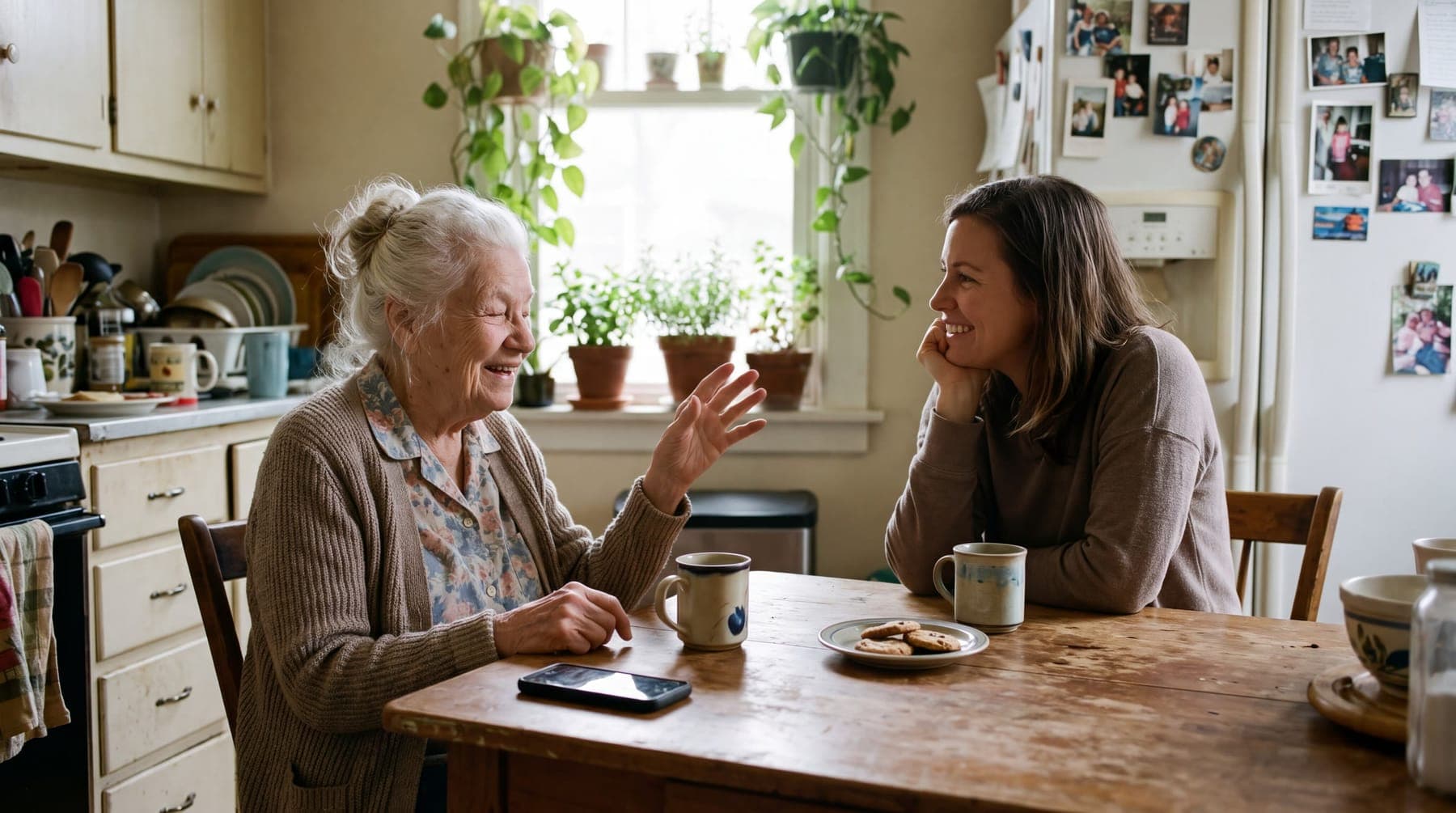
The Hanukkah gifts grandparents remember are rarely things. A night they don't have to cook, a photo they've never seen printed, a grandchild asking them a real question: small gifts like these fit across eight nights better than one big box, and none of them needs a shelf.
Hanukkah begins at sundown on Friday, December 4 this year and ends on Saturday, December 12, according to Hebcal. Below are eight ideas, one for each night if you like, and each one says who it isn't for. Every family keeps the holiday its own way, so take what fits yours and leave the rest.
1. One night they don't host
For many grandparents, the holiday means a full kitchen and a long night on their feet. Pick one of the eight nights and take it off their hands: the family comes to you, or you bring the whole meal to them, and they sit down while someone else fries and someone else washes up.
If the grandkids are old enough, put them in charge of one dish and let the grandparents judge it. That part usually becomes the story people tell the next year.
Not for a grandparent whose favorite part of the holiday is cooking for everyone. For them, offer to be the kitchen help instead, and do exactly what you're told.
2. A photo for each night
Go through the family's phones and find eight photos they've probably never seen on paper: the new baby, a grandchild's first apartment, a dog, a terrible haircut. Print them at a photo counter or at home, put each one in its own small envelope, and number the envelopes one to eight.
It costs very little, it takes up no room, and it gives them something new to open every night without a single thing to dust.
Not for grandparents who already get every photo the minute it's taken. For them, choose old photos instead and ask them to tell you who's in each one.
3. Light the candles together, from far away
If some of the family can't be there, set one night when everyone joins a video call at the same time and lights candles together, each in their own kitchen. Agree on the time a week ahead, send the link the day before, and ask someone in the room with the grandparents to set up the screen so they don't have to.
If they keep Shabbat, avoid Friday night and Saturday, which this year include the first two nights. A weeknight works for everyone.
Not for grandparents who find video calls more stressful than fun. A phone call on speaker, with everyone taking turns, does the same job with less fuss.
4. A recording of them reading to the grandkids
Ask a grandparent to read a story aloud, the one they used to read to you or one the grandkids love now, and record it on a phone. Ten minutes is plenty. Then give the recording to the grandkids as a gift from their grandparent, and give the grandparent a copy of the book they read from.
It's a present that goes both ways, and years from now it's the one the grandkids will be glad someone thought of.
Not for someone who dislikes the sound of their own voice. Ask first, and take no for an answer.
5. A question a night
Write one question on each of eight cards and let a grandchild read one aloud each night after the candles. The best questions ask for one place, one object, one evening. "What was it like when you were young?" gets a polite summary. "Where did your name come from?" gets a story about a great-aunt nobody has mentioned in forty years.
Here are eight, written so that "we didn't" is always a fine answer. Skip any that don't fit your family:
Where did your name come from?
Where did your family come from before they settled in the place you grew up?
What object in the house did your family take special care of?
What phrase did someone in your family always repeat?
If your family lit candles when you were a child, who lit them, and where did everyone stand?
What did your family eat in the winter that you haven't tasted since?
What present do you still remember getting?
How did you meet? Tell me about that day.
Five of these come straight from the bank of questions our books are built on. More are on our page of questions to ask your grandmother about her life, free to print.
Not for a grandparent who would rather not talk about the past at the table. Then keep to the lighter ones, the presents and the food, or skip this idea altogether.
6. Teach the grandkids a game from their childhood
Ask your grandparents what they played as kids, then set aside an evening for them to teach it: a card game, a street game, a counting rhyme, whatever it was. Bring whatever the game needs, a deck of cards or a piece of chalk, so they don't have to hunt for it.
Grandparents rarely get to be the expert on something the grandkids don't know yet. This gives them a night of it.
Not for grandparents who'd rather watch than play. Then ask them to referee, which is half the fun anyway.
7. A card from a different grandchild each night
If there are enough grandchildren, give each one a night and a card. The little ones draw; the older ones write three sentences about one thing they did with their grandparents that they still remember. A grandchild in college can mail theirs. Collect them, number them, and hand them over in a bundle at the start of the holiday.
Three specific sentences do more than a page of general love. "The time you let me steer the car in the parking lot" beats "you're the best".
Not if it would turn into homework the grandkids resent. One card from the whole family, with everyone adding a line, works just as well.
8. Their story, as a book
Question five, done properly. Heirleaf sends one grandparent questions about their life, one at a time, and they answer by writing or simply by talking. Their answers become a book of their life, word for word, with chapters and a contents page. How it arrives, what it costs and what it doesn't do are in the box below.
To see what a question opens up, here is "How did you meet? Tell me about that day," answered in our sample book: "At a fire company dance in the fall of sixty-four, and he didn't ask me to dance, he asked me if I wanted a Coke. Which I thought was a poor start. Then he stood there and didn't say anything for what felt like an hour, and I decided I'd have to do the talking, and I did the talking for fifty-two years."
The narrator of that sample, Helen Brooks, is invented. The question is real, and so is the way it works: it asks for one day, so the answer comes back with a dance hall, a Coke and a long silence in it.
Not for a couple who'd want to write one book together: each book is one person's life, so for two grandparents it's two books. And not for anyone who'd rather keep the past to themselves; every question can be skipped, but nobody should be talked into it.