Blog · Gifts
What to Give a Grandma Who Says She Doesn't Want Anything
By Adriana, founder of Heirleaf · Published October 30, 2026
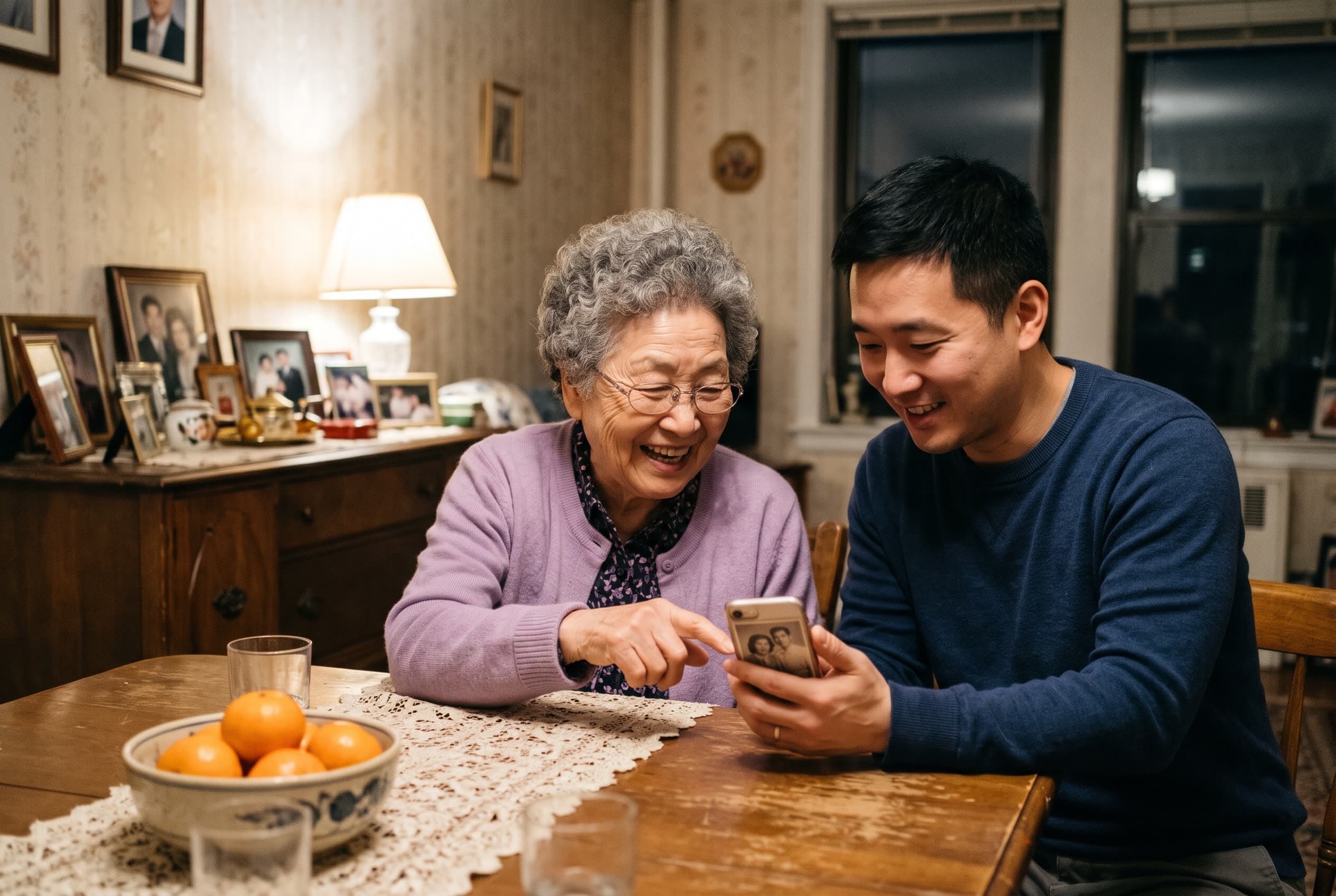
A grandma who says she doesn't want anything usually has a house full of things already, and the gift she'd really like is the family's attention in a form she can't wave away. Give her something that doesn't stay, something that brings everyone together, or something that treats what she knows as worth keeping.
Below are six ideas, from free to modest, each with a note on who it isn't for. If your mom says the same thing, we've written a separate list for a mom who says she doesn't want anything, with different ideas.
1. Her recipe cards, copied for everyone
Ask to borrow the box of recipe cards, or the notebook, for a week. Scan or photocopy every page, stains and margin notes included, and have a set printed and bound for each of her children and grandchildren. Give her the originals back in a new box, with a copy of the set on top.
Her handwriting is the point. A typed version loses the "use less sugar than it says" in the corner.
Not for a grandma who keeps her recipes to herself on purpose. Some do. Ask first, and if she says no, ask her for just one.
2. Flowers that keep arriving
A bunch of flowers is the classic gift for someone who doesn't want things, because in a week it's gone. Go one better and arrange for a small bunch to arrive every month, or take her one yourself on the same day each month. A local florist will usually set up a standing order if you ask.
She gets something new without having to find a place for it, and a reminder twelve times a year that somebody arranged it.
Not for a grandma with a garden she'd rather be cutting from herself. For her, a few bulbs or seeds of something she used to grow does the same job.
3. A calendar the grandkids fill in
Take a plain twelve-month calendar and pass it around the family before Christmas. Each grandchild, or each household, claims a month and writes in what they'll do with her: lunch out, a movie, a walk, help with the garden. She gets the calendar with every month already taken.
It's the gift that solves the usual problem with gifts of time, which is that nobody follows through. Twelve names written down tend to show up.
Not for a family spread too thin to keep it. Six months, honestly kept, is better than twelve that fall apart by April.
4. A drive past the house she grew up in
If it's within a day's drive, offer to take her back to the street she grew up on, or the town where she raised her children. Let her direct you. Stop where she wants to stop. Bring a phone to take photos, and print the best ones for her afterwards.
If it's too far, look the street up on a map service with street-level photos before Christmas, print the best view of the house as it is now, and give her that. Then ask what's changed.
Not for a grandma who left that place for reasons she'd rather not revisit. If you don't know how she feels about it, ask her where she'd like to go back to instead.
5. The family photo she keeps asking for
Most grandmothers have said, at some point, "I'd love a photo with all of you." Make it happen: pick the day the whole family is together, ask someone outside the family to take it, and print it large and framed in time for her to hang it.
If not everyone can be there this Christmas, put the date on a card instead, and make the photo the first thing on next year's calendar.
Not for a grandma whose walls are already full of family photos. Then ask her which one she'd replace, and replace that one.
6. The book of her life, from her own answers
"Nobody wants to read about me" is the usual objection, and the answer is in the questions: they don't ask for achievements, they ask for one afternoon at a time. Heirleaf sends her questions about her life, one at a time, and she answers by writing or simply by talking. Her answers become a book of her life, word for word. It's a file, not one more thing on the shelf, unless she decides to have it printed. The box below has the price and how it arrives.
Here's why it works on a grandma who claims she has nothing to say. In our sample book, the question "What were you like at seventeen?" gets this: "Oh, I thought I was something. I had a blue coat I'd saved for and I wore it in September when it was still too warm, because I wanted people to see it."
The woman who says that, Helen Brooks, is invented: she's the narrator of our sample. But the question is one of the twenty-one every Heirleaf book starts from, and it works the same way on real grandmothers, because it asks for one age and one picture, not a verdict on a whole life.
Not for a grandma who is private about her past, or who has made clear she doesn't want to talk about it. And not for one who'd only count a bound book in her hands as a present on the day, because the book comes later.
Getting her talking without an interview
Whatever you give, the holidays are when the stories come out, if you ask the right way. General questions get general answers. "What was it like growing up?" gets "we didn't have much". "Describe the street where you lived" gets the neighbors, the corner store and the dog that chased the mailman.
"What did you do for fun?" gets a shrug. "What did you do on a Saturday night?" gets the dance hall, the curfew and who walked her home. Both of the better questions come from the bank our books are built on; there are forty on our page of questions to ask your grandmother about her life, free to print with no email needed.
If she's more at home in Spanish, ask in Spanish: we keep a set written natively, not translated, on preguntas para tu abuela. And if remembering names and dates is harder for her than it used to be, ask about what she can picture rather than what she has to recall, and never correct her.